
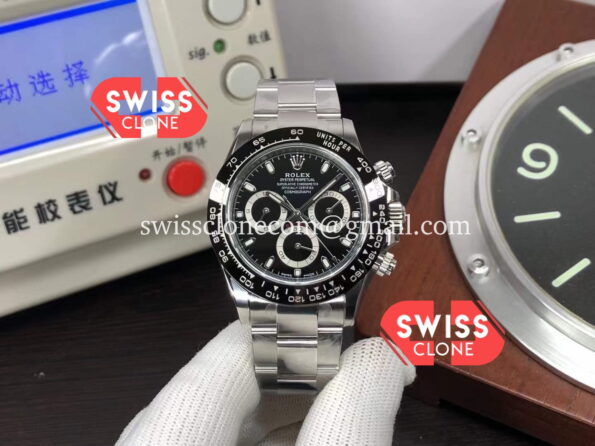
Technical Specifications and Material Engineering in High-End Replicas
Achieving a true-to-life rolex submariner replica requires more than just visual mimicry; it demands a deep dive into metallurgical precision. High-tier manufacturers have moved far beyond the era of cheap, plated metals. Today, the industry standard for premium clones involves the use of 904L stainless steel—the exact same alloy used by the original manufacturer. This specific grade of steel provides a unique luster and superior resistance to chloride-induced corrosion, which is vital for a timepiece designed to withstand saltwater environments.
The engineering extends to the bezel assembly, where the ceramic insert plays a pivotal role. Unlike lower-tier imitations that use painted aluminum, high-end replicas utilize CNC-machined ceramic. This material ensures that the scale markings remain sharp and resistant to UV degradation. When you examine the bezel’s rotation, the tactile feedback—that precise, unidirectional click—is a result of carefully calibrated spring tension and internal tooth alignment. It is these micro-adjustments that separate a generic imitation from a high-fidelity masterpiece.
Weight distribution is another silent indicator of quality. A poorly constructed replica often feels “hollow” or unbalanced on the wrist. In contrast, a premium version replicates the exact density of the original, ensuring the Oyster bracelet sits flush against the skin. The integration of the Glidelock-style clasp mechanism allows for micro-adjustments, a feature often overlooked by mass-market producers but essential for the luxury experience.
Identifying Mechanical Discrepancies in Submariner Clones
The heart of the watch—the movement—is where the most significant technical gaps appear. While many rolex submariner replica models utilize modified ETA or Miyota movements, the highest echelon of clones attempts to replicate the architecture of the Calibre 3235. You should look for features like the Parachrom-style hairspring, which offers better resistance to magnetic fields. If the movement lacks a smooth sweeping motion or exhibits visible stuttering, the escapement regulation is likely substandard.
Observing the rotor’s oscillation is also a professional tactic. A high-quality automatic movement will feature a weighted rotor that moves fluidly without excessive rattling. Any sudden, metallic clanking during wrist movement suggests a lack of precision in the module’s assembly. Furthermore, the power reserve stability is a key metric; a well-engineered clone should maintain consistent amplitude for at least 40 to 48 hours of inactivity.
The Economic Drivers of the Replica Watch Ecosystem
The global market for luxury alternatives is driven by a complex interplay of supply chain accessibility and consumer demand for “attainable” prestige. The rolex submariner replica market operates through a highly fragmented network of specialized workshops. These entities do not operate as single factories but as a web of component suppliers, assembly specialists, and logistics experts. This fragmentation allows for rapid iteration when new technical standards emerge in the luxury sector.
Economic shifts in manufacturing hubs have significantly lowered the barrier to entry for high-precision tooling. The availability of industrial-grade CNC machines and laser-etching technology means that even mid-tier producers can now replicate complex textures, such as the micro-grooves on the Rehaut ring. This technological democratization has forced a “quality arms race” within the ecosystem, where the margin between a “super clone” and a standard replica is narrowing every year.
Market Segmentation and Consumer Behavior
Consumers generally fall into three distinct categories when navigating the complexities of this market. Understanding these segments helps in evaluating the value proposition of different products. The first group seeks “entry-level” aesthetics, focusing purely on the visual silhouette. The second group, often called “enthusiast collectors,” prioritizes material accuracy, such as the 904L steel and ceramic bezel mentioned earlier. The third, most demanding group, seeks “1:1” perfection, where even the microscopic engravings on the case back must match the original.
- Visual-Centric Buyers: Focus on color accuracy and basic branding; usually opt for lower-cost, aluminum-insert models.
- Material Enthusiasts: Prioritize durability and weight; they specifically hunt for 904L steel and sapphire crystal.
- Technical Purists: Demand movement accuracy and functional complications like the date magnification (cyclops) precision.
Risks and Ethical Considerations in the Counterfeit Trade
Navigating the complexities of the rolex submariner replica market involves acknowledging the significant legal and ethical landscape. The trade of counterfeit goods is heavily regulated globally, and the supply chains often intersect with unregulated manufacturing sectors. For the consumer, the primary risk is not just legal, but also functional. Many low-cost replicas use substandard gaskets, which can lead to catastrophic water ingress and total movement failure during even minor submersion.
Beyond the physical product, there is the issue of intellectual property. The massive revenue loss experienced by luxury houses fuels a cycle of litigation and crackdowns that can disrupt the availability of high-quality components. When a major workshop is shuttered, the market often sees a temporary influx of “panic-produced” lower-quality goods. This volatility makes it difficult for a buyer to maintain long-term trust in a specific supplier or production line.
Summary of Key Identification Factors
To avoid being misled by deceptive marketing, one must focus on verifiable physical attributes rather than photographic promises. A reliable way to assess a rolex submariner replica is to perform a systematic check of the following components:
- The Crystal: Check for the “sweeping” effect of light across the sapphire; it should be scratch-resistant and have no distortion.
- The Bezel: Inspect the ceramic insert for any “bleeding” of color at the edges of the scale markings.
- The Clasp: Ensure the Oysterlock mechanism engages with a firm, singular click and that the Glidelock system moves smoothly.
- The Weight: Compare the heft to known benchmarks; a significant lightness is a red flag for 316L or base metal usage.
Frequently Asked Questions
| Question | Technical Answer | |
|---|---|---|
| How can I verify the steel grade? | Use an XRF (X-ray fluorescence) analyzer to detect Chromium and Molybdenum levels specific to 904L. | |
| Is the movement waterproof? | Only if the gaskets are high-grade Viton; always test pressure resistance before submersion. | |
| What is the difference between 316L and 904L? | 904L contains more Chromium and Molybdenum, providing much higher corrosion resistance. |
Final Thoughts on the Replica Landscape
The landscape of the rolex submariner replica market is constantly shifting due to technological advancements in micro-manufacturing. While the allure of owning a high-fidelity tribute to a legend is strong, the responsibility lies with the consumer to perform due diligence. We have seen that the difference between a disposable toy and a precision-engineered timepiece lies in the microscopic details—the alloy, the ceramic, and the movement regulation.
When sourcing from Swiss Clone, always prioritize transparency regarding the movement type and material composition. The market is vast, and while the complexities are many, a technical approach to evaluation will always yield the best results. If you are looking for unparalleled precision, Swiss Clone’s collection offers the pinnacle of engineering excellence.


