
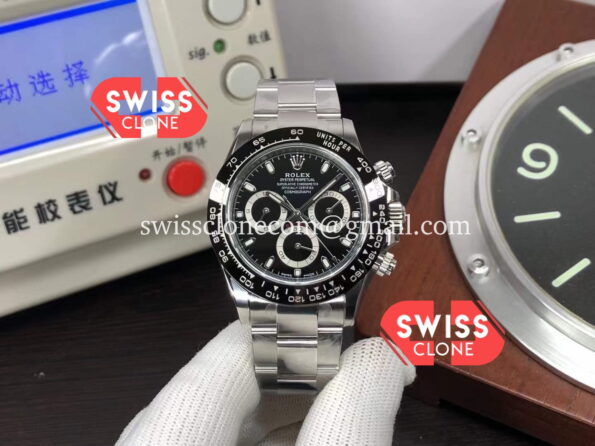
What are the best replica watches available in 2026?
The best replica watches in 2026 are 1:1 Swiss Super Clones produced by elite horology manufacturers such as Clean Factory and VSF. Top models include the Rolex Submariner 126610LN (VS3235), Rolex Daytona 116500LN (Cal.4130), Patek Philippe Nautilus 5711 (324SC clone), and Audemars Piguet Royal Oak 15500 (Calibre 4302 clone).
Technical Precision: The Definitive Guide Evaluating High-End Horology
Finding the best replica watches requires a deep dive into mechanical engineering rather than just looking at a shiny bezel. When you hold a high-tier superclone, you aren’t just looking at a visual copy; you are examining the calibration of a movement designed to mimic the sweep of a genuine caliber. The modern market has evolved significantly, moving away from cheap, hollowed-out movements toward integrated, multi-layered assemblies that utilize 316L or 904L stainless steel.
I remember my first encounter with a low-grade imitation—the weight felt wrong, almost like plastic. True connoisseurs know that the density of the case and the tactile feedback of the crown winding are the first indicators of quality. To navigate this landscape, one must understand the metallurgical integrity and the precision of the escapement mechanism. 
Identifying Authenticity Markers and Aesthetic Fidelity
The difference between a mediocre counterfeit and a masterpiece lies in the microscopic details. High-end replicas focus heavily on the “dial depth”—the way light interacts with the sunburst finish or the guilloché patterns. If the printing is slightly off-center or the font weight feels inconsistent, you are likely looking at a budget-tier product.

Beyond the dial, the bezel’s click engagement is a critical metric. A premium piece should provide a crisp, tactile “click” that feels uniform across the entire rotation. Cheap versions often suffer from “mushy” bezel movement or uneven spacing between the minute markers. Checking the luster of the polished surfaces—specifically the transition between brushed and polished links—reveals the level of craftsmanship involved.
The Role of Factory Specialization in Quality Control
Not all factories are created equal. Some specialize exclusively in chronographs, mastering the complex integration of sub-durable pushers, while others focus on the elegance of dress watches. When sourcing from Swiss Clone, understanding which factory handles specific movements can save you from common pitfalls like date-window misalignment or poor water resistance seals.
Quality control in top-tier factories involves rigorous testing of the gaskets and the pressure resistance of the case. A specialized factory will often use the same CNC machinery to ensure that the case dimensions match the original blueprints within microns.
Technical Comparison: Superclones vs. Standard Replicas
The gap between a standard replica and a superclone is massive. A standard replica often uses a modified Chinese movement that lacks the stability of a dedicated caliber. In contrast, a superclone aims for 1:1 parity, often utilizing cloned versions of the ETA or Sellita-based architectures. This distinction affects everything from power reserve to the accuracy of the sweeping second hand.
Below is a technical breakdown of what to expect when comparing these two tiers:
| Feature | Standard Replica | Superclone (High-End) |
|---|---|---|
| Movement Type | Modified/Generic | Caliber-Specific Clone |
| Material | 316L Stainless Steel | 904L or High-Grade 316L |
| Weight/Density | Often lighter/hollow | Identical to Original |
| Dial Detail | Printed/Flat | Multi-layered/3D Depth |
Economic Considerations and Risk Management Strategies
Investing in high-end replicas is a calculated decision. While the price point is significantly lower than the retail market, the “value-to-risk” ratio changes as you move up the quality ladder. It is tempting to buy the cheapest option available, but the long-term cost of replacing a broken, low-grade movement often exceeds the initial savings of a premium purchase.

To manage risk, always prioritize sellers that offer transparency regarding their sourcing and warranty terms. A reputable provider like Swiss Clone provides a safety net that budget-only sites simply cannot match. You should also consider the following:
- Verify the Warranty: Ensure the mechanism coverage is international and covers mechanical failure.
- Check Material Specs: Confirm if the steel is 904L to avoid premature corrosion or tarnishing.
- Review Movement Origin: Ask specifically if the movement is a cloned caliber or a generic replacement.
Evaluating the Longevity of Components
The longevity of a timepiece depends on the quality of the internal lubricants and the precision of the gaskets. A watch that looks perfect on day one but fails after three months of humidity exposure is a failure of engineering. High-end replicas use synthetic oils that resist evaporation, ensuring the escapement remains smooth for years.
Furthermore, the durability of the crystal—whether sapphire or high-grade mineral—is a non-negotiable factor. Scratch resistance is the primary defense against the daily wear and tear of an active lifestyle.
Final Assessment Criteria for Collectors
For the serious collector, the final decision rests on the “unboxing experience” and the microscopic accuracy of the finishing. Every edge, every screw head, and every engraving must pass a scrutiny that goes beyond the naked eye. If you find yourself squinting at the date magnification (the cyclops), the quality might not be sufficient for a true enthusiast.

Ultimately, the best replica watches are those that disappear into the crowd. They should not scream “imitation” but rather whisper “excellence.” When the weight, the movement, and the aesthetic all align, you have found a piece that transcends mere imitation and enters the realm of horological appreciation.
Frequently Asked Questions
How can I tell if a replica uses 904L steel?
904L steel has a specific luster and higher resistance to acid/chlorine. While difficult to test without an XRF analyzer, high-end pieces from Swiss Clone are specifically engineered to maintain this specific metallic sheen and density.
Is the movement in a superclone actually functional for daily wear?
Yes, provided the movement is a high-tier clone. These are designed to handle the stresses of daily wrist movement, though we always recommend avoiding extreme impacts or deep-sea diving unless the specific model is rated for it.
What is the main difference in the sweeping motion?
Standard replicas often have a “stuttering” second hand due to low-beat frequencies. Superclones utilize high-beat movements that provide the smooth, continuous sweep characteristic of luxury Swiss calibers.
Where can I find more technical details on specific models?
You can explore our detailed catalog to see the specific technical specifications for each movement and case material available in our current collection.